EOSIO Ecosystem Asset Vault
EOSIO Ecosystem Asset Vault
It’s Tuesday, November 25, 2025, and the market, in its usual dramatic fashion, decided to give NVIDIA stock a bit of a shiner. Reports surfaced that Meta, one of the biggest buyers of AI muscle, is looking sideways at Google’s custom silicon. Cue the headlines, the flash trading, and a predictable dip in Nvidia stock falls 4% on report Meta will use Google AI chips. But if you’re only looking at the red on the screen, you’re missing the signal amidst the noise.
Let’s be precise. Nvidia stock initially took a 7% tumble before settling down to a 4.3% loss later in the day. Google’s parent, Alphabet, on the other hand, was up 4.2%, extending a Monday rally. The catalyst? A report from The Information suggesting Meta is considering integrating Google’s Tensor Processing Units (TPUs) into its data centers by 2027. They might even rent some of Google’s cloud TPUs as early as next year. Now, this isn't a done deal. It’s a "consideration." But in the hyper-sensitive world of ai news today, a whisper can move billions.
Google's TPUs aren't new. They launched their first-gen in 2018, initially for internal use, a classic Google move. Since then, they’ve iterated, evolving these chips specifically for artificial intelligence workloads. The consensus among the experts—and I’ve seen enough custom silicon plays to agree—is that this specialization gives Google a distinct edge. They’re not just selling a general-purpose powerhouse; they’re offering a bespoke engine, finely tuned for specific AI tasks. Think of it like a Formula 1 team building their own engine for their car, rather than buying off-the-shelf. It's a risk, sure, but the potential for optimized performance is massive. For Broadcom, who helps Google design these TPUs, the news was unequivocally good, with their shares up over 1% after an 11% surge the previous day.
What I find genuinely puzzling in this initial market reaction is the assumption that this is a zero-sum game, a direct threat to NVIDIA’s dominance that immediately warrants a stock correction. Does Meta's consideration of Google's TPUs mean they'll abandon NVIDIA entirely? Unlikely. Data centers are complex beasts, often running heterogeneous compute environments. Google Cloud, for its part, quickly clarified to CNBC that they’re seeing "accelerating demand for both our custom TPUs and NVIDIA GPUs," and they're committed to supporting both. That’s a hedge, or perhaps a pragmatic acknowledgment of reality.
This raises a crucial question that the market seems to gloss over: How much of Meta's potential move is genuinely about superior performance or cost-efficiency from TPUs, and how much is a strategic diversification play? Relying solely on one vendor, even a market leader like NVIDIA, creates a single point of failure and limits negotiating leverage. It’s a classic corporate strategy to build redundancy. So, while the immediate nvidia stock price reaction was negative, the deeper implications are far more nuanced.
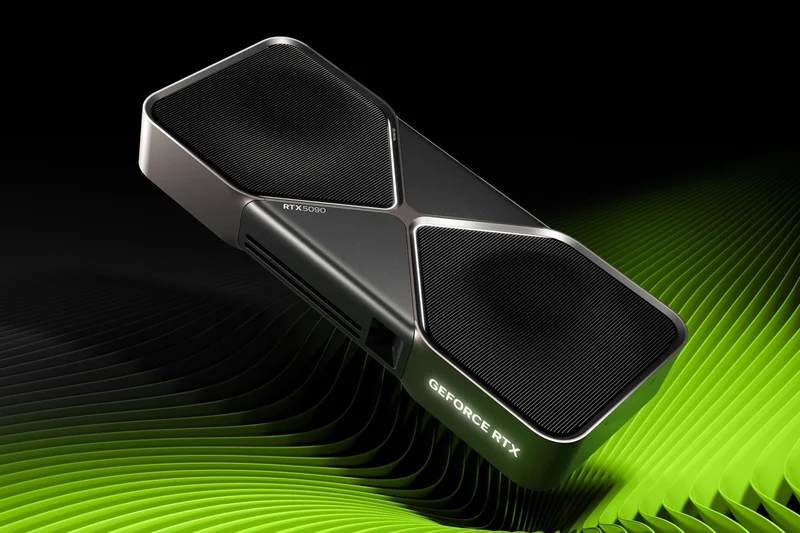
While the market was busy fretting about potential competition, NVIDIA was also quietly making moves. On the very same day, Black Forest Labs released its FLUX.2 Image Generation Models Now Released, Optimized for NVIDIA RTX GPUs, explicitly optimized for NVIDIA’s RTX GPUs. And these aren't just minor tweaks; these are substantial improvements. We’re talking about FP8 quantizations that slash VRAM requirements by 40% and boost performance by a similar margin. A 32-billion-parameter model, which would normally demand a staggering 90GB of VRAM, becomes accessible with far less, even on consumer-grade RTX cards, thanks to NVIDIA’s collaboration with Black Forest Labs and ComfyUI. This is about broadening accessibility and pushing the boundaries of what’s possible in visual generative AI, making state-of-the-art models more practical.
I've looked at these specs, and frankly, the numbers on FLUX.2 are compelling. The ability to generate photorealistic images up to 4 megapixels with "real-world lighting and physics," eliminating that tell-tale "AI look," is a significant step forward. The multi-reference feature and direct pose control are huge for artists. What this demonstrates, even as nvidia ai news gets overshadowed by competitive rumors, is that NVIDIA isn't standing still. They are actively innovating, collaborating, and deepening their ecosystem. It’s a race, yes, but NVIDIA is still building faster engines and better tracks simultaneously.
And let’s zoom out for a second. The broader market on Tuesday was actually quite robust. The Dow Jones Industrial Average surged more than 1% (specifically, 1.4% or 664 points), the S&P 500 climbed 0.9%, and the Nasdaq Composite added 0.7%. Even with the nvidia stock news creating a drag, the market as a whole overcame it. Economic data, like retail sales undershooting expectations (up 0.2% in September), and producer prices ticking up 0.3%, didn't derail the positive sentiment. Rising expectations for a Fed rate cut continue to buoy spirits. So, while NVIDIA’s dip was notable, it wasn't a systemic shock. It was a single stock reacting to a speculative report within a generally positive market.
The immediate market reaction to Meta's flirtation with Google TPUs feels a lot like watching a driver swerve hard at the sight of a squirrel, completely ignoring the open road ahead. Yes, competition is real, and Google’s custom silicon is a legitimate player. But to assume a single client's consideration of an alternative immediately cripples the reigning champion overlooks NVIDIA’s relentless innovation, their deep ecosystem, and the sheer scale of the AI compute demand still expanding globally. It's not about one chip or one customer; it's about the entire AI infrastructure landscape, which is still very much NVIDIA’s domain. The numbers, when you look beyond the intraday swings, suggest a more complex, multi-vendor future, not a sudden dethroning.